


Magnetic Material Types and Differences
In this article we will talk about magnetic materials.
Magnetic Materials are those materials, those if we put in magnetic field, they
will be magnetised easily.
 |
| Types of Magnetic Material and differences |
Diamagnetic, Paramagnetic, and Ferromagnetic Materials
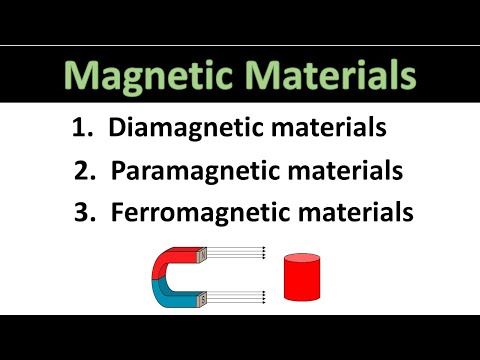
Mainly there are three types of magnetic materials:
1) Diamagnetic Materials
2) Paramagnetic Materials
3) Ferromagnetic Materials
This article will tell you that what are the key
differences in these three materials.
1) Diamagnetic Material
a) If a diamagnetic material will near to any magnetic
material, it will weakly repelled by that magnet. It means it shows some weak
repulsion.
b) If we put a diamagnetic material in any magnetic
field, it will weakly magnetised but in opposite direction. Its value is
negative and small due to weak nature.
c) If we put a diamagnetic material in a magnetic field,
the magnetic field lines will start move away from material. That material
repel those field lines from its centre.
d) If we put a diamagnetic material in a Non-Uniform
magnetic field, it will move from strong field towards weak field. Because It
is repelled by that field region.
e) If we remove external magnetic field from diamagnetic
material, then it will loose its magnetism. It does not have unpaired
electrons.
f) Diamagnetic materials can be solid, liquid and gases
as well. Examples: Water, copper, Mercury, gold, hydrogen etc..
2) Paramagnetic Material
a) If a paramagnetic material will near to any magnetic
material, it will weakly attracted by that magnet. It means it shows some weak
attraction.
b) If we put a paramagnetic material in any magnetic
field, it will weakly magnetised in same direction. Its value is positive and
small due to weak nature.
c) If we put a paramagnetic material in a magnetic field,
the magnetic field lines will start closer to material. That material attract
those field lines from its centre.
d) If we put a paramagnetic material in a Non-Uniform
magnetic field, it will move from weak field towards strong field. Because It
is attracted by that field region.
e) If we remove external magnetic field from paramagnetic
material, then it can loose its magnetism. But It has unpaired electrons.
f) Paramagnetic materials can be solid, liquid and gases
as well. Examples: Aluminum, Platinum, Sodium, Crown glass etc..
3) Ferromagnetic Material
a) If a ferromagnetic material will near to any magnetic
material, it will strongly attracted by that magnet. It means it shows strong
attraction.
b) If we put a ferromagnetic material in any magnetic
field, it will strongly magnetised in the same direction. Its value is positive
and large due to strong nature.
c) If we put a paramagnetic material in a magnetic field,
the magnetic field lines will start strongly closer to material. That material
strongly attract those field lines from its centre.
d) If we put a ferromagnetic material in a Non-Uniform
magnetic field, it will move from weak field towards strong field. Because It
is strongly attracted by that field region.
e) If we remove external magnetic field from
ferromagnetic material, They do not lose their magnetism. Because it is
permanent Magnet. It also has unpaired electrons.
f) Ferromagnetic materials are only solid. Examples:
d) If we put a ferromagnetic material in a Non-Uniform
magnetic field, it will move from weak field towards strong field. Because It
is strongly attracted by that field region.
e) If we remove external magnetic field from
ferromagnetic material, They do not lose their magnetism. Because it is
permanent Magnet. It also has unpaired electrons.
f) Ferromagnetic materials are only solid. Examples:
Iron, nickel and cobalt.
This is a explanation video, you can watch for better
understanding.
Tags
#magneticmaterial #magnets #diamagnetic #paramagnetic
#ferromagnetic